








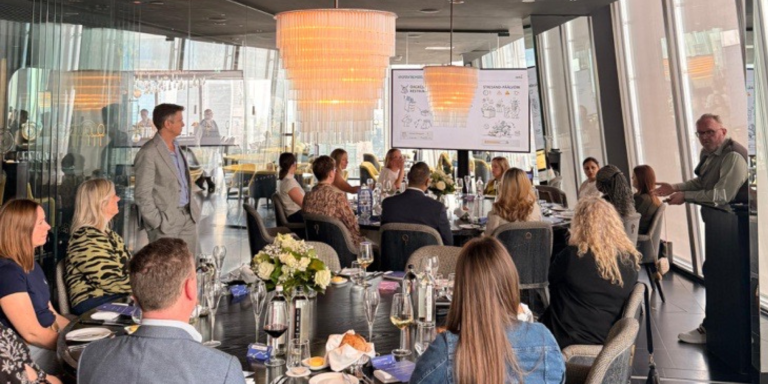
Last month, Steve and Perry spent the afternoon at The Shard with some of the leaders helping to define HR’s next chapter as we enter a formative period for the function – one in which AI is beginning to reshape the architecture of HR.
In this article, Steve and Perry break down some of the key points covered during the discussion in their very own words.
There’s a moment happening in HR right now that feels both familiar and quietly radical.
We’re in a live transition: A messy in-between where expectations are shifting faster than the structures built to support them. Familiar, because we’ve been here before – through digital transformation, through the rise of SaaS, through mobile-first work, through the pandemic and the reconfiguration of where and how work happens.
And yet, this moment feels different.
Underneath the excitement, the pilots and CoPilots, the dashboards and assistants, something more fundamental is being revealed:
The way we organise work – particularly through HR – no longer fits the world we’re in.
The flat-pack illusion
For years, we’ve treated the HR operating model as something to design, implement and stabilise. A kind of organisational furniture. Neatly constructed. Logically arranged. Built to last.
It’s elegant on paper. Reassuring in PowerPoint. But in practice?
It often feels like flat-pack furniture assembled under pressure:
- instructions that don’t quite match reality
- missing pieces disguised as “local adaptation”
- awkward joins between teams that were never meant to fit together
And most tellingly, a lingering sense that, even when assembled, it doesn’t quite do what we need it to do anymore.
The model was built for a more stable, predictable, process-driven world of work. We don’t live there (nor furnish things this way) now.
The quiet truth about HR models
But there’s an uncomfortable truth that we must acknowledge. Nobody (except HR) really cares about HR operating models. Not employees. Not most leaders.
What they care about is whether work works. Whether it feels coherent, supportive, fair… human.
Whether they can:
- do meaningful work
- navigate their careers
- feel safe and included
- contribute without friction
- grow, adapt and belong
Operating models only matter insofar as they enable those things. And increasingly, they don’t.
AI as a mirror for how work really operates
This is where AI enters the story – but not in the way most narratives suggest.
We’ve been told AI is a revolution, a disruption, a technological leap. All true.
But its most important role right now might be this: AI is acting as a mirror – it’s showing us the gaps in our systems.
The data tells its own story. Leaders are experimenting, adopting, exploring, and the pace of AI investment is accelerating, with AI startups raising $2.4 billion in the first half of 2025, representing 30 percent of all UK venture capital raised in that period. But across the workforce, confidence is lower, capability is uneven, and meaningful adoption remains patchy.
Zellis’ recent research report, ‘The Grey Zone’ reveals that when it comes to AI, there’s adoption without alignment. While 94% of leaders say they use AI, and 64% say it improves work quality, 38% of employees are not using AI.
Find out more about ‘the untapped advantage of AI alignment’ here
AI has been introduced as a layer. What’s needed is a redesign of the fabric.
More human than we realise
One of the more intriguing shifts in thinking is this: AI isn’t just another piece of IT.
It behaves differently. It learns. It adapts. It recognises patterns. It responds to context. It improves through feedback. In other words, it operates in ways that feel – surprisingly – human.
Which creates a tension. Because we’re trying to integrate something dynamic, adaptive, and fluid into organisational systems that are anything but.
It’s like introducing improvisational jazz into a room still governed by sheet music.
Which means our approach also must be “human-first”
The most important shift AI is prompting is rethinking how the function runs end-to-end. Let digital systems handle the repeatable, rule-based work, and free HR to show up with judgement and care when situations are nuanced. The currency here is trust, and that comes from consistent fairness, sound decisions and employee experiences that hold up in the moments that matter.
And HR provides the practicality angle – with a repeated focus on moving beyond experimentation towards scalable change. That means anchoring change in real, repeatable use cases, investing in the basics (data, governance, capability), and choosing an operating model that improves in small, continuous iterations rather than lurching from one big redesign to the next.
A different kind of leadership question
As AI becomes more embedded, new questions start to surface. Not technical ones, but human ones.
- Who decides what “good” looks like?
- Where does accountability sit when work is co-created with machines?
- How do we balance autonomy and oversight?
- What does capability even mean in a world where intelligence is distributed?
These aren’t questions you can answer with a framework alone. They require judgement, ethics, leadership. And perhaps most importantly, intentional design.
From model to movement
What begins to emerge from this is not a better version of the same model, but a different way of thinking entirely. Instead of asking, “How should HR be structured?” we ask, “How should work actually function?”
That leads to a more integrated, living system – one that blends:
- the intentionality of products
- the embedded nature of systems
- the centrality of people
- the adaptability of processes
- and the grounding of science
But crucially, it’s not static. It behaves more like a product than a structure – something iterated, refined, continuously improved.
The shape-shifting organisation
If HR changes in this way, the organisation itself cannot remain fixed. This is where the idea of the polymorphic organisation comes into play.
In biology, polymorphism describes the ability to take multiple forms depending on context. In computing, it’s about adapting behaviour based on inputs.
In organisations? It’s about responsiveness.
The ability to:
- reconfigure around work, not hierarchy
- flex roles based on capability, not job titles
- align people dynamically to problems and opportunities
- evolve continuously rather than restructure periodically
AI doesn’t drive this on its own, but it makes it possible. It enables a level of visibility, coordination and adaptability that traditional systems simply couldn’t support. Living in an integrated way across the organisation’s tech stack, it now has the impact to shift the organisation from something static and engineered to something that is all of that and importantly, thinking more and therefore alive.
Adoption is the real work
Of course, none of this happens just because tools exist. If there’s a consistent lesson from early AI deployments, it’s this: The barrier isn’t capability. It’s understanding.
- AI usage fails because the use cases aren’t clear
- the workflows aren’t redesigned
- the expectations aren’t explicit
- the learning isn’t embedded
Which means the real work is adoption.
And that’s where HR has a pivotal role to play -as an architect of how work evolves. When organisations are clear that AI is there to inform judgement rather than replace it, confidence grows, capability follows and value is unlocked. Alignment turns AI from a source if uncertainty into a catalyst for better decisions, better work and more resilient workplace cultures.
AI doesn’t fail because the technology isn’t ready; it fails when people aren’t. Education is needed at every level, from the boardroom to the front line, turning AI from a mysterious black box into a trusted partner, so that leaders and employees can confidently use it to strip out the drudgery, sharpen decisions and improve working lives. When organisations invest in building that understanding and keep humans firmly in the driving seat, AI stops being a threat and becomes a catalyst for a more open, creative and truly transformative workplace for everyone.
Be the carpenter
At its core is a simple idea: HR can choose whether to be shaped by this moment, or to actively shape it: Put simply, “be the carpenter, not the nail.”
It’s simple. But it cuts through. HR can either be shaped by this moment – reacting and absorbing the pressure. Or it can shape it.
Designing systems where:
- AI enhances rather than overwhelms
- people grow rather than get displaced
- work becomes more meaningful, not less
What this moment really asks of us
It’s tempting to see AI as the headline. The thing to respond to. The thing to implement. The thing to keep up with. But that risks missing the deeper invitation.
Because this isn’t just a technology shift. It’s a chance to rethink how work actually works, and to move beyond inherited models. To design something more fluid, responsive and more human. Something that can change shape as the world changes around it.
AI may be the catalyst.
But the real story?
Is whether we’re willing to rewrite the HR operating model itself.