








New research reveals the substantial untapped economic and cultural value of improving AI alignment.
- £40bn a year in productivity value stands to be unlocked
- An estimated 1.7 billion hours of staff time available annually to be redeployed
- A further £20bn a year in operating-cost savings could be realised
- Three-quarters of both employees (75%) and leaders (74%) believe productivity would improve through better AI alignment
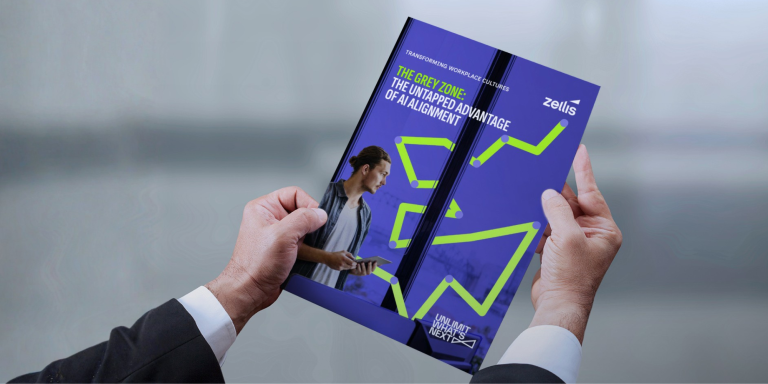
BRISTOL, UK – 10 February 2026: New research from Zellis, the UK and Ireland’s leading provider of HR, pay, workforce management (WFM), and benefits solutions, reveals that UK organisations could unlock £40 billion a year in productivity gains, and a further £20 billion a year in operating-cost savings through better AI alignment between leaders and employees. The findings are published today in The Grey Zone: The Untapped Advantage of AI Alignment.
The AI Grey Zone
The report uncovers the considerable gap between how leaders believe AI is used and how employees experience it day-to-day. Zellis describes this area of misalignment as an AI “grey zone”, where adoption is widespread but impact, confidence and usage is uneven.
The research found that:
- 94% of business leaders surveyed say their organisation uses AI tools, but only 61% of employees say they use AI in their role.
- Employees are far more likely to want AI applied to routine, administrative tasks: 69% saying basic data entry and checking should be AI-led, compared with 44% of leaders.
- Leaders are more likely to want AI used in higher-stakes decisions: 35% of leaders believe promotions and pay decisions should be AI‑led, compared with only 8% of employees.
- 63% of leaders whose organisations use AI say they involve employees or teams in decisions around its use – but only 40% of employees using AI agree they feel involved, and a third (33%) disagree that they’re involved.
Unlocking billions for businesses
Better AI alignment, adoption and integration in the workplace represents an immense, untapped productivity and cost-saving opportunity.
Both leaders and teams recognise this: three-quarters of employees (75%) and leaders (74%) believe productivity would improve if AI were better aligned with how work is actually done. Both groups estimate that around 8% of working time could be redirected to higher-value activities through more effective AI alignment. Applied across large organisations in the UK, this equates up to an estimated 1.7 billion working hours a year, potentially worth around £40 billion in redeployable staff time.
The opportunity goes even further. Leaders estimate that improved alignment could unlock a further £20 billion in potential operating-cost savings. In fact, one in five (20%) leaders say that better use of AI could cut operating costs by 7-10%, freeing up to £1 in every £10 to reinvest elsewhere.
“This research shows just how big the AI opportunity really is. When better alignment on AI could unlock up to £60 billion a year for UK organisations, leaving that value unrealised isn’t an option,” said Abigail Vaughan, CEO of Zellis. “The data makes clear this isn’t just about AI adoption, but about making sure AI is implemented with transparency and collaboration, and in ways that genuinely support how people experience work to reach their potential.”
Increasing AI expectations
Across the UK and Ireland AI is increasingly seen as integral to the workplace.
- A third (34%) of employees said they expect their employer to provide access to AI tools that will help them do their job more effectively within the next year, rising to nearly two-thirds (63%) within the next two years.
- Almost half of leaders (47%) say advanced digital and AI skills will be required in their organisation within the next year, rising to more than three-quarters (77%) within the next two years.
- 74% of leaders say employee upskilling will become increasingly important over the next two years.
Furthermore, the way leaders handle AI also has a direct impact on employee retention, morale and wellbeing.
- Two in five employees (40%) say transparent use of AI would make them more likely to stay with their employer, while a similar proportion (42%) say it would improve trust in leadership.
- 51% of employees and 59% of leaders who use AI agreed AI reduces work-related stress, rising to 62% among employees aged 18-34.
- Three in five (61%) employees aged 18-34, who use AI, agreed it has helped them be more confident in their role.
- Younger employees are more open to AI leadership and engagement, with 58% agreeing that their feedback on AI use is valued and acted upon, compared to much lower confidence across the wider workforce, where only 45% believe senior leaders are using AI effectively, and just 40% feel involved in decisions about how it is used.
These changing expectations around AI are being shaped by its current use. Millennials and Gen Y are currently the most active users with (69%) of those aged 29-44 using AI at work and 27% doing so regularly. As this generation becomes the backbone of the workforce, and future leadership, their patterns of use are setting the standard for what “normal” looks like at work.
“As AI becomes a baseline expectation for performance, progression and job satisfaction, organisations that fail to provide the right AI tools and training risk losing the best talent and falling behind competitors.” said Steve Elcock, Director of Product – AI, Zellis. “AI doesn’t fail because the technology isn’t ready; it fails when people aren’t. Our findings show employees are enthusiastic about AI when it’s used to remove friction from everyday work, but more cautious when it’s positioned as the decision-maker in higher stakes areas like pay and progression. That isn’t resistance to AI, it’s about education and trust. When organisations are clear that AI is there to inform judgement rather than replace it, confidence grows, capability follows and value is unlocked. Alignment turns AI from a source of uncertainty into a catalyst for better decisions, better work and more resilient workplace cultures.”
“The findings show a clear advantage for organisations that focus on AI alignment, not just adoption. By embedding AI across HR, pay, WFM and benefits in ways that support people and build trust, employers can improve the speed and quality of their work and create stronger workplace cultures – an approach Zellis helps organisations to deliver,” said Vaughan. “When leaders involve their people, communicate clearly and use AI to inform rather than replace human judgement, organisations can elevate their work and empower employees to be their best. There’s huge value to be gained through AI when attention is paid to alignment.”
The report includes comparative charts highlighting where leaders and employees diverge most on AI use, alongside visuals showing how the time and cost savings have been calculated from the survey data.
The full report, The Grey Zone: The Untapped Advantage of AI Alignment, is available here: The Grey Zone: The Untapped Advantage of AI Alignment Report – Zellis.