








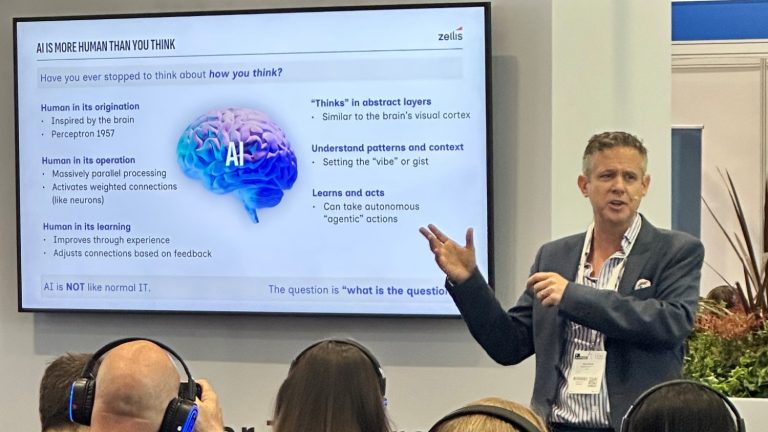
HR Tech 2026 made one thing unmistakably clear. We are no longer talking about if automation will transform HR and payroll – that chapter is already written. The real story now is about what comes next.
Across two days of conversations, demos and standing-room-only seminar sessions, one theme consistently rose to the top – a fundamental shift from task-based automation to intelligent, goal-driven systems that can act, adapt and orchestrate work. For HR and payroll leaders, this represents a true leadership moment.
The shift: from AI assistance to Agentic AI
For many years, HR and payroll teams have been supported by increasingly sophisticated tools – dashboards, workflows and automation layers.
Agentic AI reframes that model. Instead of asking “How do I run payroll faster” or “How can I do surface the data I need to compile my report” the question becomes, “How can I surface insights to make informed decisions about the future” and “How can the system handle this for me, if I put the right guardrails in place?”
Agentic AI changes the equation, moving from assistance to execution. Instead of simply delivering on individual, predefined tasks, agentic systems can:
- Understand goals
- Make decisions within guardrails
- Coordinate across systems and workflows
- Continuously learn and improve
For HR, it means shifting from administrative delivery to strategic orchestration of workforce experiences.
For payroll, it could mean systems that don’t just process pay runs, but proactively identify anomalies, resolve issues, perform checks and communicate with employees.
If you couldn’t get there, here’s some of the key takeaways from our seminar sessions across the two days.
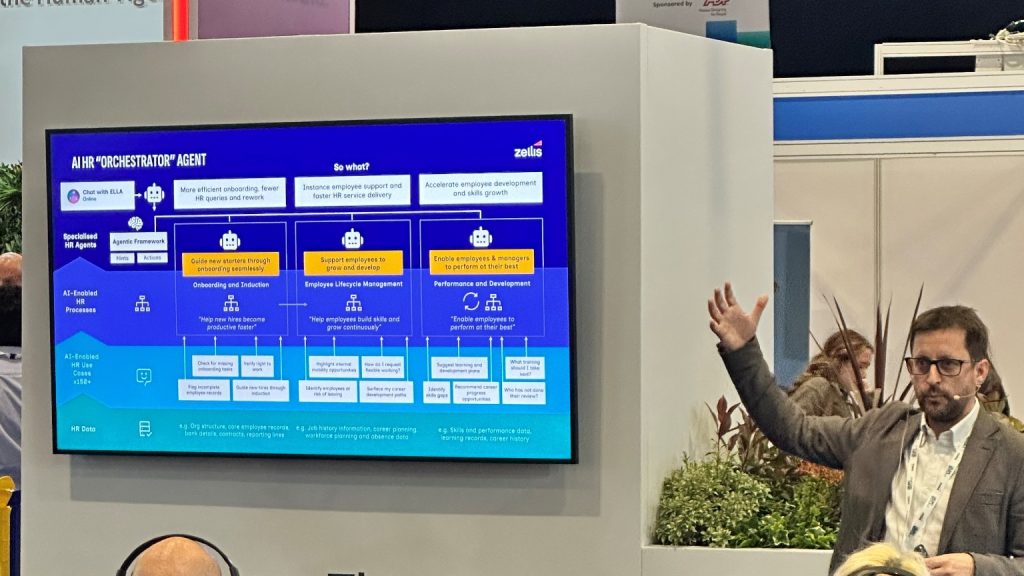
Session 1: Being the Carpenter, Not the Nail: HR’s Role in the Age of Agentic AI
Speakers: Steve Elcock, Winston Poyton
Day one set the strategic tone with a simple but powerful provocation: In the age of agentic AI, will HR shape the future, or be shaped by it?
Steve and Winston challenged HR leaders to rethink their role – not as downstream adopters of technology, but as active architects of how AI is introduced, governed and scaled across organisations.
Key takeaways
- Agentic AI must be human-first
Agentic AI is powerful, but its value depends on how it complements people. The session emphasised that human-first AI is not a constraint — it’s a design principle. HR is uniquely positioned to ensure AI enhances work, rather than eroding trust or transparency. - Governance is not optional
With systems capable of autonomous decision-making, governance becomes a core HR responsibility. This includes: ethical frameworks, clear accountability, transparency in decision-making, and risk management. HR must help define not just what AI can do, but what it should do. - HR must own the AI agenda
Too often, AI adoption is driven by IT or external vendors. This session made it clear that HR cannot afford to be passive. Becoming “the carpenter” means: Setting Organisational principles for AI use, defining workforce impact, and partnering across functions to shape implementation - Start small but start deliberately
Leaders were encouraged to avoid paralysis. Instead: identify high-impact and low-risk use cases, build internal confidence and benchmarks for impact, and scale with governance in place. Attendees left with a practical framework for evaluating agentic AI and a roadmap for responsible adoption – grounded in strategy, not hype.
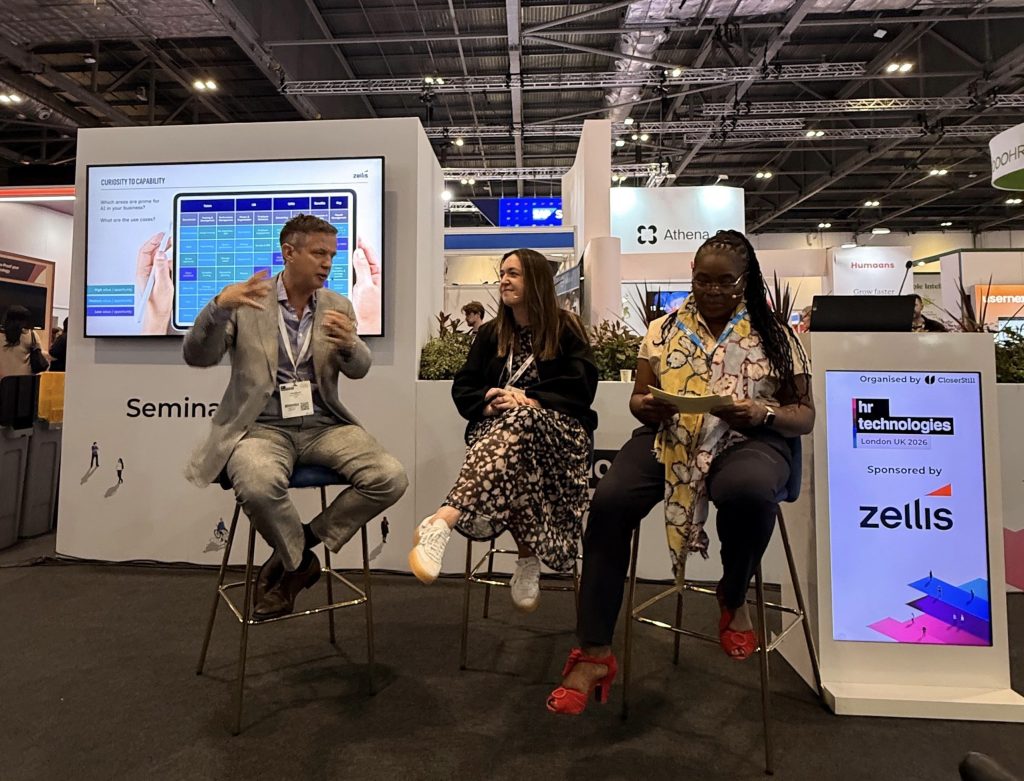
Session 2: From Hype to How: Making Human-First AI Work in HR Practice
Speakers: Sasha Watson, Steve Elcock, Lauren Carroll (Wesleyan)
If day one asked who should lead, day two answered how to actually do it.
Hosted by Zellis CPO Sasha Watson, this session brought a refreshingly honest, practical perspective moving beyond theory into real-world adoption.
Key takeaways
- Start with problems, not technology
One of the clearest messages – AI initiatives fail when they start with tools instead of challenges. The panel emphasised: identifying operational pain points, focusing on measurable outcomes, and building use cases that connect data to process to value. - Progress over perfection
Lauren Carroll shared Wesleyan’s early journey adopting AI in partnership with Zellis – highlighting that the first iterations are not about perfection, but about learning, testing and iterating. This grounded perspective resonated strongly: early use cases are often narrow but impactful, internal trust builds through visible wins, and that capability grows over time. - Partnership accelerates capability
The collaboration between Wesleyan and Zellis illustrated how organisations can move faster by combining: domain expertise (HR & payroll), technology capability (AI platforms), and real-world feedback loops. - The next 6–12 months will be pivotal
Looking ahead, the panel explored how quickly organisations can evolve from: experimentation to structured adoption; pilots to embedded workflows; and insight to autonomous action.
For those in earshot, the takeaway was clear: the window to move from curiosity to capability is now.

What this means for HR and Payroll Leaders
Across both sessions, a consistent narrative emerged:
Agentic AI is not just another technology wave; it is the evolution of how HR and payroll functions operate. Leaders now face three critical imperatives:
Lead, don’t follow
HR must step into a strategic leadership role in AI adoption – shaping governance, ethics and workforce impact.
Anchor in real value
Success will not come from experimentation alone, but from solving real problems that matter to employees and organisations.
Build for the future, now
The shift to agentic AI is already underway. Organisations that act early (thoughtfully and responsibly) will be best positioned to benefit.
So, will HR be the nail – shaped by technology?
Or the carpenter – shaping how technology transforms work and employee experience?
At Zellis, we stand ready and excited to support HR and payroll leaders and their organisations unlimit what’s next. If you missed seeing us at HR Tech 2026 or would like to continue the conversation, then get in touch today to speak with one of our experts.