
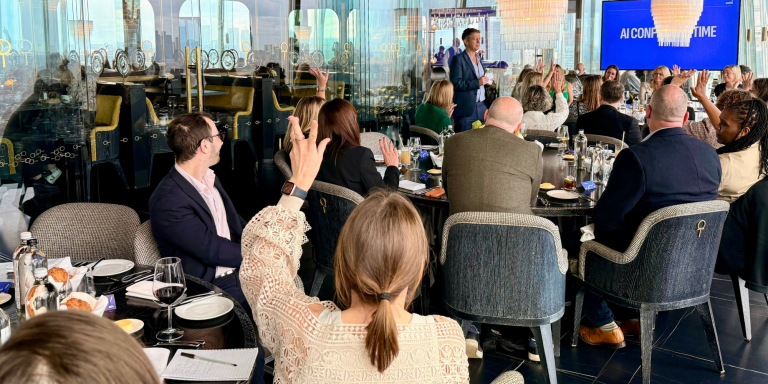
On 25th March, Zellis brought together Chief People Officers and HR Directors at Aqua Shard for ‘AI Turning Point: Rewriting the HR Operating Model’, a hosted lunch designed to explore how AI is beginning to reshape the architecture of HR, and what it means to redesign the operating model so it can evolve alongside the organisation it serves.
The event was hosted by Perry Timms, Founder of People and Transformational HR and one of the HR industry’s most influential leaders, and Steve Elcock, Director of Product, AI at Zellis, who focused on what happens when AI becomes a meaningful layer in the system of work, shaping how HR delivers services and designs experiences, and therefore requiring an operating model that is treated as a living blueprint, capable of being updated as work changes, while keeping the function more human where it matters most.
Why the turning point feels real, now
Over the past few years, HR has navigated successive shifts that have changed expectations of work and support, with hybrid patterns becoming established for a significant portion of the workforce, and with employee priorities continuing to evolve in ways that directly affect attraction, retention and engagement.
As of early 2025, 28% of working adults in Great Britain regularly engaged in hybrid work, which underlines how quickly the “default” working week has diversified across roles, sectors and life stages.
At the same time, work-life balance has overtaken pay as the leading motivator globally for the first time, which is a strong signal that employee experience and organisational design are now inseparable from performance and workforce outcomes.
Against this backdrop, the pace of AI investment is accelerating, with AI startups raising $2.4 billion in the first half of 2025, representing 30 percent of all UK venture capital raised in that period, which helps explain why so many organisations are moving from curiosity to intent, while still grappling with what “good” adoption looks like in practice.
This was the context for AI Turning Point, because when the world of work is changing at pace and AI capability is advancing quickly, HR’s operating model increasingly determines whether the function can respond with confidence and consistency, while still protecting the human judgement and trust that employees rely on.
The operating model as an instruction manual for change
The conversation returned to a familiar tension for many HR leaders, where operating models have often been treated as relatively fixed structures, even as the organisation around them has become more dynamic, more distributed and more dependent on timely insight.
Perry introduced the idea of the polymorphic HR operating model, a term he uses to describe disciplined adaptability, where HR can reconfigure its form while preserving its function, and where the operating model becomes capable of evolving in context.
What made this useful in the room was the clarity it brought to a complex challenge, because the idea gives HR leaders language for an operating posture that can shift shape without losing the outcomes that matter, including fairness, transparency and a coherent employee experience.
This is also where the session connected strongly with the practical reality of HR today that the HR leaders discussed in the room, since AI has started to reshape expectations of service, insight and responsiveness, and the operating model is the mechanism that determines whether HR can meet those expectations without creating hidden risk.
Themes that kept surfacing, and why they matter
A recurring theme in the discussion was the idea that AI changes how people interact with HR, because employees increasingly expect to ask questions in natural language, find policy guidance quickly and move through processes with fewer handoffs, which places new emphasis on HR’s data and knowledge foundations.
This led naturally into the question of readiness, since AI outcomes depend heavily on the quality, accessibility and governance of the information it draws on, and because many HR teams have inherited fragmented policy estates and inconsistent data structures that limit what AI can safely support.
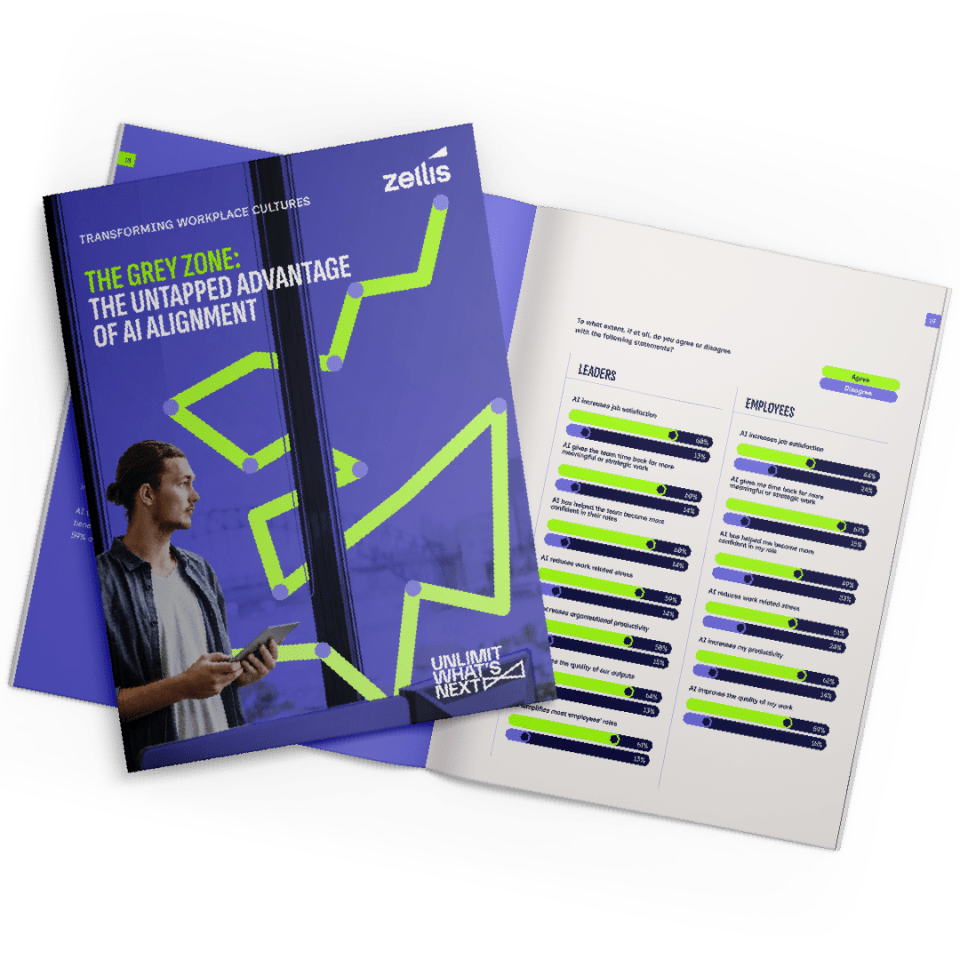
See how Zellis helps you prepare AI-ready data, with governance and controls that protect confidence
Another theme centred on how organisations should respond to employee-led AI usage, since research indicates that a significant share of UK workers keep their AI use quiet at work, which increases the importance of clear guidance, accessible approved tools and an approach to capability-building that supports confidence and accountability.
The session also explored the practical value of looking at AI through the lens of tasks, because when work is decomposed into the activities that sit underneath roles, it becomes easier to identify where AI can remove friction, improve quality, or support managers with timely prompts and insight.
Throughout the afternoon, Steve and Perry returned to the idea that HR work operates across multiple levels, from tasks and processes through to objectives, and that AI capability is moving quickly across those layers, which is why operating model decisions need to account for more than entry-level automation.
Keeping AI human
One of the most valuable threads in the session was the emphasis on human-first design, particularly when the discussion moved into employee relations and other high-trust interactions, where the conversation focused on setting sensible boundaries, reducing process “sludge” where appropriate, and protecting the moments where empathy, judgement and context are essential.
Fundamentally, as AI begins to reshape the architecture of HR, the real opportunity is to redesign the operating model so that technology carries more of the repeatable, codified work, while HR becomes more human where it matters most, because trust is earned through sound judgement, fairness and the integrity of the experience employees have at the moments that count.
Another standout aspect of the conversation was the way the group leaned into practicality, with a repeated focus on moving beyond experimentation towards scalable change, grounded in real use cases and strong foundations, and supported by an operating model that can evolve through continuous improvement rather than periodic reinvention.
From an afternoon discussion to a wider agenda
AI Turning Point was designed as an in-room conversation, although the themes travel well beyond the table, because the questions raised are now common across large organisations, including how to set governance that enables progress, how to build workforce confidence and how to redesign HR’s instruction manual so that it keeps pace with a world where AI is increasingly embedded in day-to-day work.
If there was a single message that carried through the session, it was that the organisations that benefit most from AI will be those that treat HR’s operating model as a living system, capable of disciplined adaptability, grounded in strong process and evidence and built to support human judgement at the points where it matters most for trust and performance.